

Our Organoid-Based Phenotypic Screening Services provide a powerful platform for drug discovery, target validation, and personalized medicine development. By integrating advanced organoid models with automated screening systems, we enable high-throughput, biologically relevant screening with high accuracy and repeatability.
We offer a range of services, including Organoid High Throughput Screening (oHTS), which evaluates drug candidates and their effects on specific targets. Our Organoid Multi-omics Analysis integrates genomics, proteomics, and other techniques to provide deep insights into disease mechanisms and biomarker identification. Additionally, Gene Editing Organoid-Based Target Analysis allows for precise gene editing and target validation, enhancing drug development efforts and facilitating personalized treatment strategies.
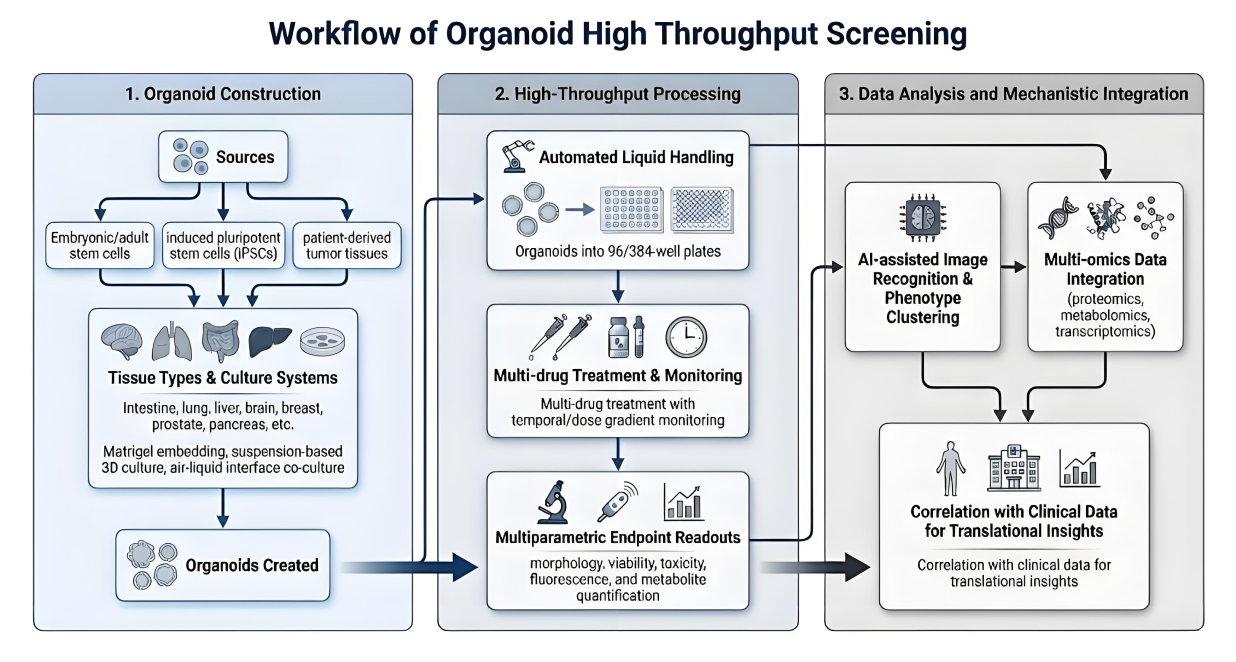
Organoid High Throughput ScreeningOrganoid high throughput screening (oHTS) refers to the integration of organoid models with automated screening systems, enabling applications in drug discovery, toxicity assessment, target validation, and personalized medicine development. This service is designed to identify potential drug candidates and assess their impact on specific drug targets. Through an automated screening process, we offer high accuracy and lot-to-lot repeatability, ensuring that the results are biologically relevant and can be directly applied to drug development.
Multi-omics analysis integrates genomics, transcriptomics, proteomics, and metabolomics to comprehensively analyze the molecular characteristics of biological samples, particularly in human disease models. Techniques such as whole genome sequencing (WGS), whole exome sequencing (WES), and RNA sequencing (RNA-seq) uncover genetic mutations and transcriptional alterations. Proteomic approaches including phosphoproteomics and mass spectrometry imaging, explore protein functions and cellular signaling pathways. Phenotypic assays (e.g., cell proliferation, senescence, apoptosis) and functional assays (e.g., phosphorylation, reporter gene assays) validate target functions. By integrating clinical data and phenotypic information, multi-omics analysis enhances the discovery and validation of targets and biomarkers, driving advancements in precision medicine.
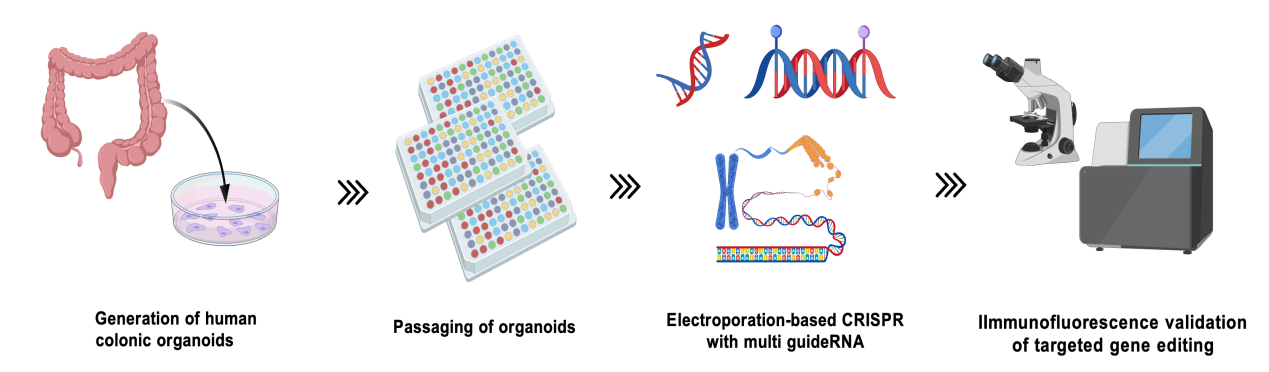
Gene Editing Organoid-Based Target Analysis and Validation ServicesOur services include the construction of high-quality Gene-edited Organoids (GDOs) and provide comprehensive gene editing solutions. This encompasses designing gene-specific editing strategies and primer sets, selecting the appropriate cell source, and delivering gene editing tools using methods such as transfection, electroporation, or viral vectors. We evaluate gene editing efficiency using techniques like PCR and sequencing, and combine 3D organoid culture and differentiation technologies to simulate the characteristics and functions of the target organ. Finally, we validate the editing effects through target gene expression analysis, functional studies, and drug response testing.
Key Advantages:
Target Modeling: Gene editing technology allows precise editing of target genes to control expression levels within organoids, achieving target modeling.
Precision-medicine research: Human tumor organoid models combined with multi-omics analysis effectively enhance target discovery and validation efficiency, providing tailored solutions for drug response and target validation.