Human Intestinal Organoids: Advanced 3D Models for Gut Biology and Drug Discovery
The gastrointestinal tract plays critical roles in nutrient absorption, metabolism, immune regulation, and maintaining human health. However, traditional 2D cell culture models often lack the complex architecture and cellular interactions required to better represent key aspects of human intestinal biology.
Human intestinal organoids have emerged as advanced 3D cell culture models that recapitulate selected aspects of human intestinal biology, providing valuable platforms for studying intestinal development, disease mechanisms, drug responses, and drug discovery applications. By maintaining tissue-like structures and key cellular characteristics, intestinal organoid models enable more comprehensive investigations of human gastrointestinal biology.
Human Intestinal Organoids for Biomedical Applications
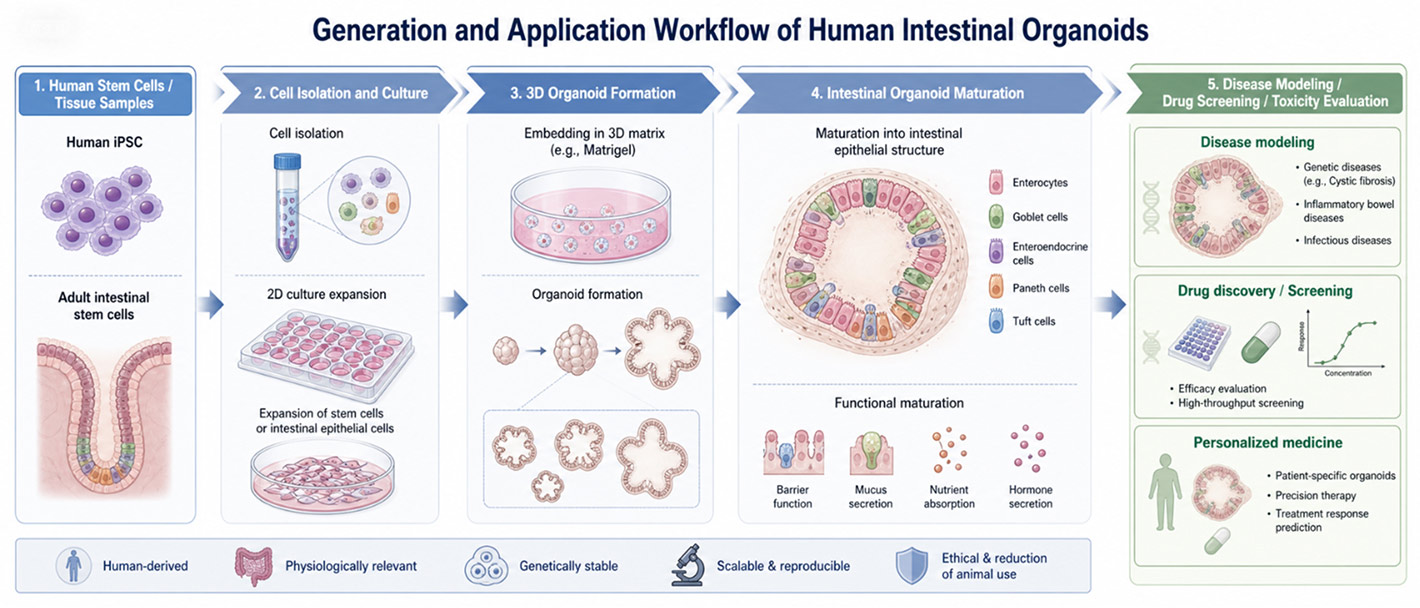
Human intestinal organoid systems can support research in areas including intestinal development, disease modeling, drug screening, drug evaluation, and toxicity assessment. Compared with conventional 2D culture systems, intestinal organoid models provide 3D tissue-like structures that recapitulate selected aspects of human intestinal biology and support investigations of complex biological processes.
As advanced intestinal organoid models, these platforms also serve as valuable intestinal epithelial models for studying epithelial functions, cellular interactions, and tissue-level responses.
Key applications include:
Intestinal disease modeling: Supporting studies of gastrointestinal disorders, including inflammatory bowel disease (IBD) and genetic intestinal diseases through human-relevant platforms for organoid disease modeling.
Drug discovery and screening: Providing human-derived platforms for evaluating compound responses, efficacy, and potential toxicity. These models support modern drug discovery and drug development by providing human-relevant platforms for compound evaluation and functional screening.
Intestinal biology research: Enabling investigations of epithelial differentiation, intestinal barrier function, and cellular interactions.
Different Types of Human Intestinal Organoid Models
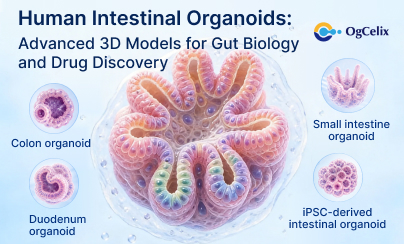
OgCelix provides a portfolio of human intestinal organoid models designed to support diverse research applications, including Human iPSC-Derived Intestinal Organoid (C-001), Human iPSC-Derived Colon Organoid (C-002), Human Small Intestine Organoid (C-004), and Human Duodenum Organoid (C-005).
Human iPSC-Derived Intestinal Organoid (C-001)
Generated from human induced pluripotent stem cells (iPSCs), Human iPSC-Derived Intestinal Organoid (C-001) is a human intestinal organoid model developed for in vitro research applications.
Human iPSC-Derived Colon Organoid (C-002)
Human iPSC-derived colon organoid (C-002) provides a valuable model for studying colon-related biological processes, including epithelial function, colon development, and cellular responses. This iPSC-derived colon organoid model supports applications in human colon organoid research, colon biology studies, and compound evaluation.
Human Small Intestine Organoid (C-004)
Human Small Intestine Organoid (C-004) is designed for studies focused on small intestinal structure and function. It can support studies of intestinal barrier function, nutrient absorption-related processes, epithelial responses, and compound evaluation.
Human Duodenum Intestinal Organoid (C-005)
Human Duodenum Intestinal Organoid (C-005) represents the duodenal region of the gastrointestinal tract and supports research on upper intestinal biology, epithelial responses, and drug absorption.
OgCelix Human Intestinal Organoid Products
| Product |
Cat. No. |
Origin |
Application |
| Human iPSC-Derived Intestinal Organoid |
C-001 |
Human iPSC-derived |
Intestinal development, differentiation, drug response |
| Human iPSC-Derived Colon Organoid |
C-002 |
Human iPSC-derived |
Colon biology, epithelial studies |
| Human Small Intestine Organoid |
C-004 |
Human tissue-derived |
Intestinal function and compound evaluation |
| Human Duodenum Intestinal Organoid |
C-005 |
Human tissue-derived |
Upper intestinal biology and absorption studies |
Advantages of Human Intestinal Organoid Models
Compared with traditional 2D cell culture systems, intestinal organoid models provide:
- Physiologically relevant 3D tissue-like structures
- Improved representation of human intestinal tissue characteristics
- Support for organoid disease modelingand organoid drug screening
- Flexible platforms for regenerative medicine research and drug discovery research
These human-derived models may also contribute to optimizing the drug development process by providing more biologically relevant testing platforms.
Conclusion
Human intestinal organoids represent advanced tools for studying gastrointestinal biology and supporting pharmaceutical research. By providing human-derived 3D cell culture models, intestinal organoids help researchers investigate disease mechanisms, evaluate therapeutic responses, and support improved strategies for drug discovery and drug development.
Advances in organoid technology continue to expand applications in regenerative medicine research and biomedical research by providing more physiologically relevant models for understanding human biology.
OgCelix offers a range of intestinal organoid products, including Human iPSC-Derived Intestinal Organoid (C-001), Human iPSC-Derived Colon Organoid (C-002), Human Small Intestine Organoid (C-004), and Human Duodenum Intestinal Organoid (C-005), supporting diverse applications in intestinal biology research, organoid drug screening, and drug discovery.